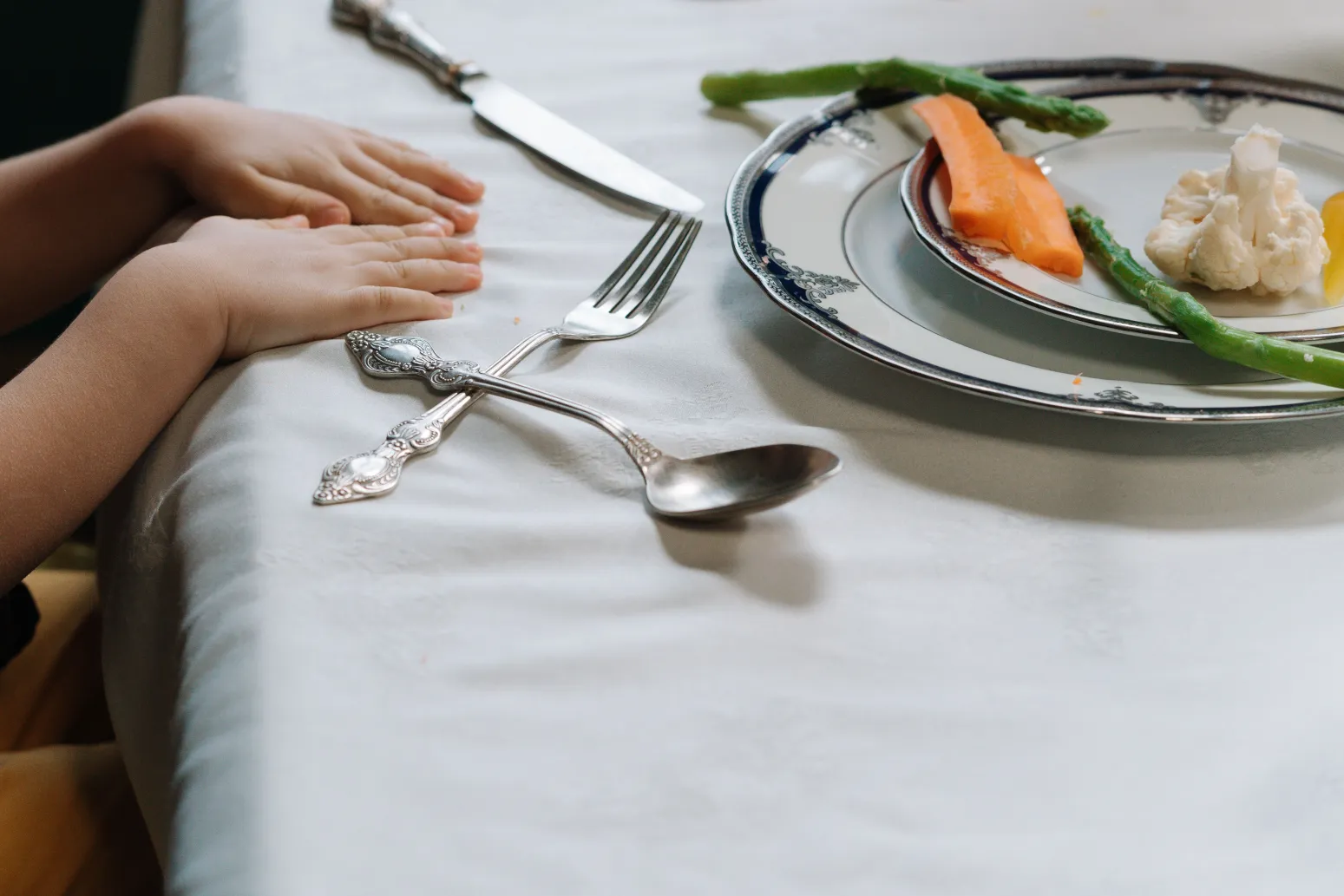
The plate has been in front of him for an hour. His mother is following him round the room with a spoon. His father says "leave him, he will eat when he is hungry". His grandmother says he looks thin and needs something to open his appetite.
This happens in a great many households and causes genuine anxiety. This article is about the difference between what is normal at this age and what needs to be seen.
First question: "will not eat" or "will not eat what we want"?
There is a large difference between the two, and it changes everything.
Dr Rana says she does not begin with a solution: "When a mother comes in and tells me 'my son doesn't eat at all', the first thing I say is not 'try giving him this'. I ask her first."
The questions she starts with:
What does "not eating" mean? How many meals does he eat?
What does he actually eat through the day?
Is he drinking milk or juice in large amounts?
Is he eating snacks between meals?
Does he refuse all food, or particular things?
When did the problem start?
And how are his weight, his height and his growth doing?
The reason is that those answers lead to two completely different places: "Sometimes the child genuinely has a problem that needs assessment, and other times we discover that he is eating — but the amount is less than the family expected."
A child who eats five foods and refuses the rest is not the same as a child whose total intake is small. The first is food selectivity, which is very common and usually a phase. The second is a different matter and is assessed clinically.
A useful first step: actually write down everything the child eats over two days — including milk, juice, biscuits, and the mouthful taken in passing. The picture that emerges is usually different from the impression.
The indicator is growth, not the plate
This is the most important point in the article.
The World Health Organization has child growth standards used worldwide, and their central idea is that a child follows a curve — not a single point. A child tracking steadily along her curve is growing well even if the eating looks sparse to her family.
And NICE has guidance devoted to faltering growth in children, which approaches the question through the curve and change over time rather than through the amount eaten at a meal.
So the right question is not "how much did he eat today?" — it is "is he tracking his curve?". And that answer sits with the paediatrician and the growth chart, not at the dinner table.
The physiology: why appetite falls after the first year
This is the piece of information that resolves half the anxiety, and very few people have been told it.
The rate of growth in the first year is very fast — a baby gains a proportionally large amount of weight in a short time. After the first year the rate of growth falls markedly and stays slower for years.
And energy requirement follows the rate of growth. So a child who ate with enjoyment at ten months and refuses at eighteen has not "changed" or become spoiled — her actual requirement has fallen relative to what it was.
Parents compare with what used to be, and that comparison makes something normal look like a problem.
Food neophobia: a phase with a name
There is a stage at which children refuse new food almost automatically, appearing usually after the first year and continuing for years through the pre-school period.
This is a recognised developmental stage, understandable as protective behaviour: a child who has become mobile is more cautious about anything new being put into her mouth.
The important part: refusal at this age is not a final verdict on the food. It is an initial reaction, and it changes with exposure.
What research says about repeated exposure
There is a consistent observation in research on children's eating behaviour: acceptance of a new food increases with repeated neutral exposure — offered at the table without pressure, without reward, and without comment.
And the number of exposures needed is usually far greater than parents expect. Most parents try a food two or three times and conclude the child does not like it, and that conclusion stops the exposure, which fixes the refusal in place.
Pressure works in reverse. Forcing food associates it with an unpleasant experience, which reduces acceptance over the long run rather than increasing it.
Dr Rana puts the mother's part in all of this into two sentences: "Your job is not to make him finish the plate. Your job is to provide suitable, balanced food at regular times in a calm environment, and to keep offering a variety of foods without pressure."
And the result is not immediate, which is part of the design: "And gradually the child learns to hear his own hunger and fullness cues."
The division of responsibility: who decides what
There is a principle in child feeding stated in a good deal of guidance, including material published by the American Academy of Pediatrics, and it comes to this:
Parents decide what food is offered, when, and where. The child decides whether to eat, and how much.
The principle looks simple and resolves most of the conflict at the table, because it stops the pursuit with a spoon on one side and stops serving alternatives on demand on the other. What usually happens is that these boundaries get swapped: parents try to control the amount, and the child controls the kind of food by refusing.
Milk: the thing that looks like a solution and is part of the problem
This is a practical point that changes a great deal quickly.
When a child refuses food, the natural reaction is for parents to compensate with milk — at least he drank some milk. The difficulty is that milk in large amounts does two things at once: it fills a small stomach and so reduces solid food, and cow's milk is poor in iron.
So the temporary solution feeds the problem: less solid food means less iron, and low iron reduces appetite in its own right.
The American Academy of Pediatrics discusses iron deficiency in young children and its relationship to consuming large volumes of cow's milk at this age.
Tea does the same thing from another direction: it reduces iron absorption, and it is given to children in a great many Egyptian households.
Two opposite myths
"Leave him, he will eat when he is hungry." There is something right in this — pressure does not work — but the conclusion is wrong. Withdrawing food as a punishment, or using hunger as a tool, turns eating into a battlefield, and a child who learns that food is a matter of authority resists harder.
"Chase him and put it in his mouth." This buys today's mouthful at a long-term cost: food becomes associated with coercion, and acceptance falls.
The two share something: both make eating a negotiation between two parties. And the answer is not a midpoint between them — it is for eating to become an ordinary routine again.
Dr Rana says this is the commonest mistake she sees: "mealtimes turning into a battle." The forms that battle takes are familiar: "one more spoonful", "if you finish your plate I'll give you a sweet", chasing him round with the spoon, putting a screen on so that he eats without noticing, or comparing him with his brother.
And the cost is not paid at that meal: "All that pressure can make the child associate food with tension instead of with hunger and fullness."
"Something to open his appetite" — the thing bought at the pharmacy
A practical point, because it happens constantly: parents go to the pharmacy and ask for something to open the child's appetite.
These products vary — some are vitamins, some contain substances with genuine pharmacological effects. And the problem is not whether they work; it is that they get taken before anybody asks the first question: is there a reason for the poor appetite at all?
Because poor appetite may be normal at this age, and it may be a symptom — of iron deficiency, or of something else. A product that increases eating without addressing the cause conceals the symptom and delays assessment.
And anything taken regularly should be mentioned to the paediatrician, even if it was bought without a prescription.
The routine itself does work
There are simple things about the shape of a meal that matter more than people expect, and require no product at all:
Eating at roughly consistent times, with the meal having a beginning and an end rather than staying open for an hour.
The child sitting with everybody at the same table, eating the same food, even a small amount of it.
Phones and television off during the meal, because attention to food is part of registering fullness.
Familiar foods on the table alongside anything new, so the child finds something she recognises.
And most importantly: no commentary on the eating. No praise, no blame, no negotiation. A meal with no talk about food goes far more calmly.
In an Egyptian kitchen
Food is usually served to the child on a separate plate, which removes something that matters: the child seeing everybody around her eating the same food. Exposure happens by watching as much as by tasting.
Home cooking offers good options for this age: mashed lentils and foul, eggs, rice pudding, boiled vegetables, potato, areesh cheese, yoghurt, minced meat in moussaka or soup, and seasonal fruit.
Snacking between meals is the silent problem: crisps, biscuits and sweetened juices fill a child between meals so she arrives at the table not hungry, and the refusal then gets read as "he does not eat".
And gatherings and visits bring pressure from adults — eat, darling, for my sake. That pressure comes from affection, and has the same effect as any other pressure.
Small things that reduce appetite without anybody noticing
There are things in a day that work against the meal without anybody connecting the two. Dr Rana lists them:
Snacks throughout the day.
Drinks before the meal.
Very large amounts on the plate.
Or the moment he refuses the meal, rushing to make him the one dish he likes.
What they have in common is that all of them are done with the best of intentions, and all of them bring the child to the table not hungry.
Signs that should not be reassured away
This article is reassuring in most situations, which is exactly why it has to say what is not reassuring.
These are the signs at which Dr Rana says this is no longer simple selectivity:
If there is:
- weight loss or faltering growth
- clear difficulty chewing or swallowing
- repeated vomiting
- pain with eating
- choking or repeated coughing while eating
- a very sharp narrowing of the list of accepted foods
- or a sense in the family of a large and continuing change
then this needs specialist assessment, and not "he'll grow out of it".
And that list is not exhaustive. Chronic diarrhoea, recurrent abdominal pain, blood in the stool, or persistent pallor and lethargy are also seen by a paediatrician, not managed by adjusting the dinner table.
Worth remembering
The indicator is growth along the curve, not the size of a meal. And appetite falls after the first year because the rate of growth falls — that is physiology, not spoiling.
Refusing new things is a phase with a name; acceptance increases with repeated neutral exposure and decreases with pressure. Parents decide what, when and where; the child decides whether and how much.
And milk in large volumes looks like a solution while reducing both solid food and iron at once.
If any of the signs on the list above is present, this is not selectivity — it is a doctor's appointment.
As Dr Rana puts it: "The goal is not for the child to 'finish his plate'. The goal is to build a healthy relationship with food, and at the same time to follow his growth and make sure he is getting what he needs. Because with a child who is not eating, the first thing we need to understand is this: is he genuinely not eating enough, or are we expecting him to eat more than he needs?"
If it is continuing and you want an assessment: child nutrition or book an appointment.
And there is an article on introducing food in the first place: questions that keep coming up about feeding.
References
This article reports the recommendations of named bodies. These are the documents it reports, so that you can go and read them yourself.
- World Health Organization. Child Growth Standards.
- National Institute for Health and Care Excellence (NICE). Faltering growth: recognition and management. 2017.
- American Academy of Pediatrics (AAP). Child feeding guidance — the division of responsibility in feeding.
- American Academy of Pediatrics (AAP). Iron deficiency in young children and cow's milk intake.
Share this
These buttons carry no tracking. The link opens on your device, and we do not learn that you shared it.